United Nations System Mapping on Access to Justice
United Nations System Mapping on Access to Justice

United Nations System Mapping on Access to Justice
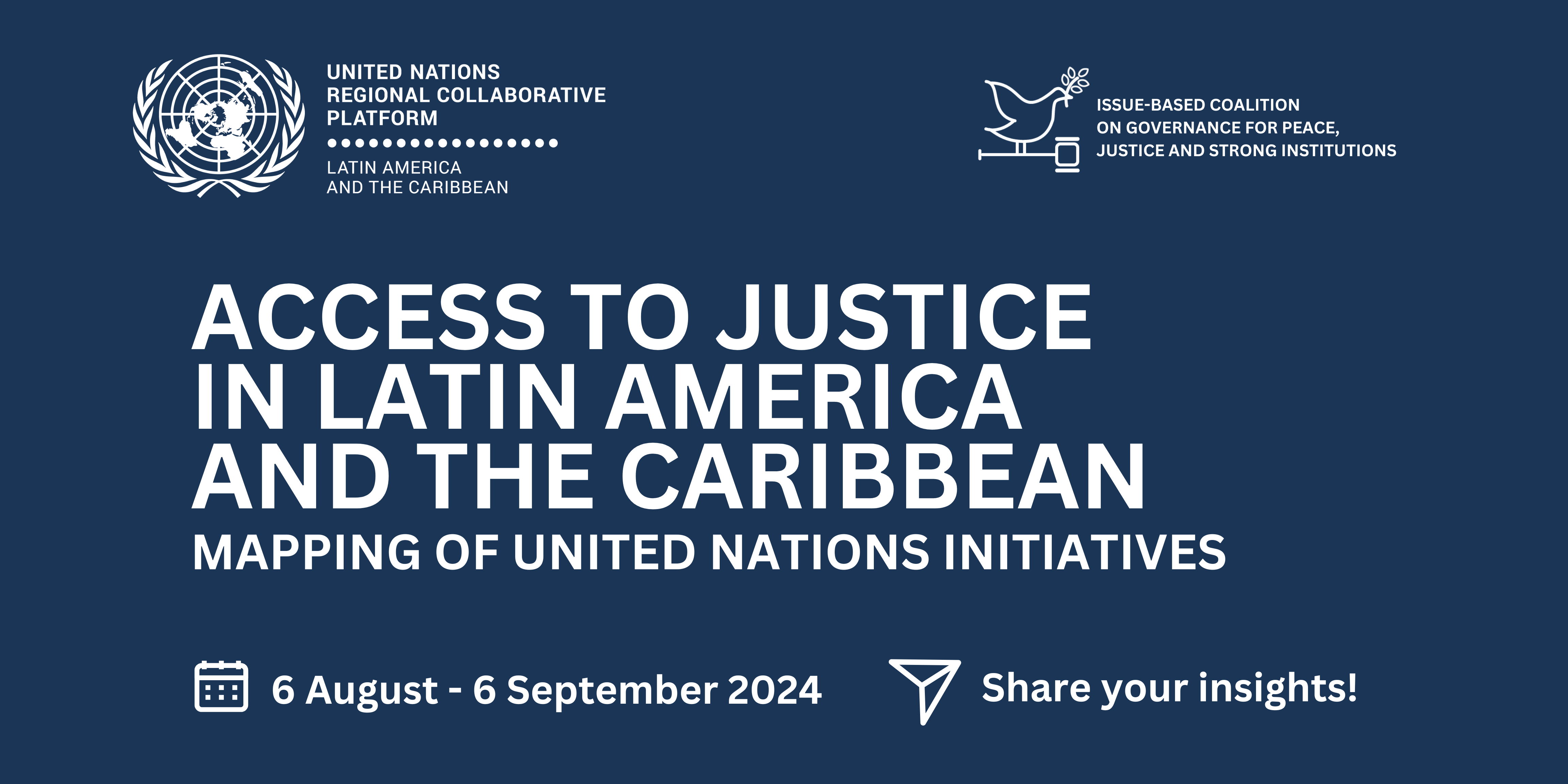
Initiatives implemented in Latin America and the Caribbean
CONTEXT
Access to justice is at the heart of the 2030 Agenda, as sustainable peace and development cannot be achieved without justice. Within SDG 16 “Peace, Justice and Strong Institutions”, States commit to provide access to justice for all, recognizing it as a key enabler of peaceful and inclusive societies, particularly through Target 16.3 “To promote the rule of law at the national and international levels, and ensure equal access to justice for all”. Moreover, access to justice is instrumental in supporting inclusion and combatting discriminative practices, and cross-cutting to the fulfillment of most other SDGs, such as those concerning poverty (SDG 1), health and well-being (SDG 3), gender equality (SDG 5) and inequality (SDG 10).
To guarantee that every individual has meaningful access to justice, mechanisms and systems need to be available for fair resolution of disputes, redress for human rights violations and accountability for wrongdoings. People need to be aware of their rights, empowered to claim them and be free to make their own choices along the process.
While multiple international legal instruments reference access to justice, including the Universal Declaration of Human Rights and the International Covenant on Political and Civil Rights, efforts have been made in several regions to enshrine rights pertaining to access to justice in regional mandates. Latin America, in particular, has made efforts since 2021 towards the adoption of an Ibero-American Convention on Access to Justice, with the involvement of the Conference of Ministers of Justice of Ibero-American Countries (COMJIB), the Ibero-American Judicial Summit (CJI), the Ibero-American General Secretariat (SEGIB), the Presidency of the Ibero-American Access to Justice Programme (PIAJ) and the EUROsociAL Programme of the European Union. On the same line, an Ibero-American Alliance for Access to Justice was established in 2022 as a network of representatives of the vast ecosystem that works for justice in the region, led by PATHFINDER.
Within this framework, and pursuant to the objectives of the Latin American and Caribbean Regional Collaborative Platform, an Issue-Based Coalition (IBC) on Governance for Peace, Justice and Strong Institutions was established under the co-chair of UNODC and UNDP. The IBC comes as an inter-agency coordination platform to provide a regional UN response to the cross-cutting challenges towards the achievement of SDG 16, helping to establish synergies and scaling-up the of work of the various UN entities working on the issue.
OBJECTIVE
The IBC on Governance for Peace, Justice and Strong Institutions has pledged a system-wide mapping of all the international, regional and national initiatives currently fostered by UN Agencies, Funds, Offices and Programmes on access to justice. To achieve this, the IBC has prepared a dedicated survey meant for regional and/or country offices to showcase their initiatives, including concrete activities, proposed solutions, tools and knowledge products.
With this information, the IBC will more effectively identify opportunities for synergies, knowledge exchange and joint implementation.
PARAMETERS
Definitions
For the purposes of this survey, “access to justice” should be understood as the ability of people to defend and enforce their rights and obtain just resolution of their legal problems in compliance with human rights standards, if necessary, through impartial formal or informal institutions of justice and with appropriate legal support.
For the purposes of this survey, “initiatives” should be understood as programmatic activities, services or products undertaken by UN Agencies, Funds, Offices and Programmes. While these initiatives might be framed as outcomes of specific projects, they can include public campaigns, ad hoc agency products, or one-time activities not formally implemented through a project. Please include the adherence to initiatives led by government counterparts. Please include inter-agency initiatives where the responding entity plays a leadership of key role. Please exclude initiatives led by other UN Agencies where the responding entity plays a minor or supporting role.
Reference period
Survey responses should include all initiatives undertaken since 2020, irrespective of whether they have been finalized or if they are currently ongoing. This timeframe includes initiatives that started before 2020, but that were finalized after January 1st, 2020. If available, please include initiatives set to start before December 31st, 2024.
Location
Survey responses should include all initiatives implemented in Latin American and Caribbean countries. Please include international initiatives that have implementation in any of the LAC countries, even if they are also implemented outside the region. Please include international initiatives that are promoted in LAC by the responding entity, even if there is no specific national differentiation (such as international campaigns).
Response integration
UN Agencies, Funds, Offices and Programmes should try to consolidate their response through their regional offices for Latin America and the Caribbean. In case there is no regional office, the responses should be collected by the agency focal point and submitted in bulk.
Deadline
The consolidated responses should be submitted to Gloria Manzotti gloria.manzotti@undp.org and Antonino De Leo (antonino.deleo@un.org) by Friday, 6 September 2024 COB.
Questions and follow-up
Should any questions arise, you can contact the IBC co-chairs Gloria Manzotti gloria.manzotti@undp.org and Antonino De Leo (antonino.deleo@un.org)